Star Charts, Not Scripts
What Polynesian Navigation Teaches Us About Structuring AI Agent Workflows
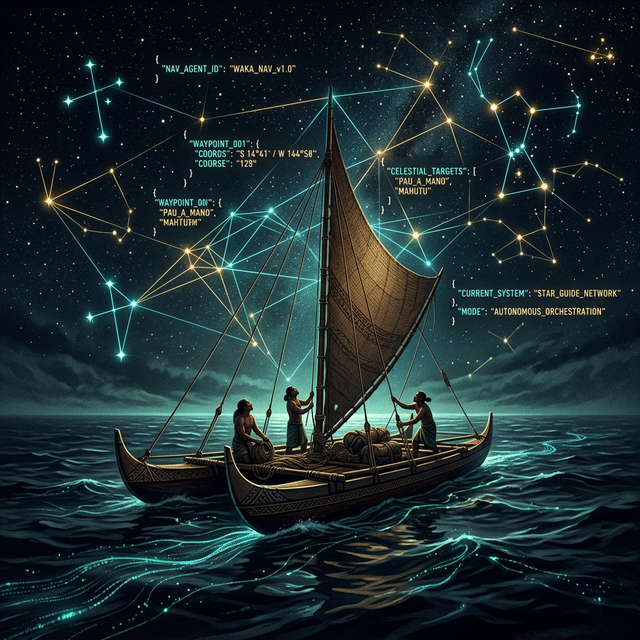
TL;DR: AI agents follow prose instructions the way a tourist follows a phrasebook — technically correct, but drifting with every sentence. Structured specs eliminate that drift the same way star charts eliminated guesswork for Polynesian navigators. Structure and intuition aren't opposed. Structure is what makes reliable intuition possible.
The Problem With Prose
Most AI agent workflows today are written as markdown documents. Step-by-step prose. Natural language. Human-readable and flexible.
This works — until it doesn't.
A recent experiment by at0mic tested the same complex workflow (29 action steps, 3 human decision gates, multiple tools) across three leading AI models in two formats: prose instructions vs. structured JSON specifications.
The results were decisive:
| Metric | Prose Instructions | Structured JSON Specs |
|---|---|---|
| Improvised steps | 4–10 extra steps per model | Zero across all models |
| Validation compliance | ~40% (12/29 checks) | ~97% (27/29 checks) |
| Cross-model consistency | 5-point score spread | 1-point score spread |
Every model given prose instructions invented extra steps. Claude Opus added 10. Sonnet added 5. Gemini 3 Flash added 4. Each model improvised differently, making outputs unpredictable.
With JSON specs: all three models produced zero invented steps. The spec was the spec. Nothing more, nothing less.
The Navigator's Lesson
Here's why this matters beyond engineering.
Polynesian navigators crossed the largest ocean on Earth — 16 million square miles — without instruments, without charts on paper, without GPS. But they were not unstructured. They were among the most precisely structured navigators in human history.
The difference is what was structured and how.
A Western sailor follows a script: written instructions, compass bearings, plotted coordinates. Turn left at 15°S. Proceed 200 nautical miles on heading 270°. The instructions are prose. The navigator interprets them.
A Polynesian navigator follows a star chart: a structured specification of relationships between stars, swells, wind patterns, and bird flight lines. The stars don't improvise. The swells don't skip validation checks. The structure is embedded in the medium itself — not in a document that requires interpretation.
The star chart is the structured spec. The ocean is the execution environment. The navigator applies judgment within the structure, not instead of it.
Structure doesn't replace intuition. Structure is the substrate that makes intuition reliable.
What Structured Specs Actually Look Like
In the at0mic experiment, each workflow step becomes a structured object with explicit actions, tool calls, and mandatory validation:
{
  "step_id": "create-project-repo",
  "type": "action",
  "description": "Initialize the project repository",
  "tool": "git_init",
  "parameters": {
    "name": "{{project_name}}",
    "visibility": "private"
  },
  "validation": {
    "check": "repository_exists",
    "expected": true,
    "on_fail": "retry"
  }
}
Five step types cover all workflow patterns:
| Type | Purpose | Navigation Equivalent |
|---|---|---|
| action | Do something | Paddle stroke, sail trim |
| gate | Wait for human input | Reading the horizon before committing to a heading |
| condition | Branch on state | Adjusting course based on swell direction |
| loop | Iterate | Tacking against wind until clear |
| group | Organize sub-steps | The overall voyage leg between islands |
The critical insight: every action step must include a validation block. If it's missing, the spec fails before it can be used. The structure enforces verification — it doesn't merely suggest it.
This is the difference between writing "please check your work" in a markdown file (which agents skip ~60% of the time) and embedding verification as a structural requirement (which agents comply with ~97% of the time).
Why This Resonates With Pacific Intelligence
In The Third Point, I mapped two types of intelligence:
- Land-based intelligence (Eastern/Western): positional, grid-based, territorial. "Where am I on the map?"
- Ocean-based intelligence (Pacific): vectoral, relational, triangulated. "Where am I heading, relative to what's moving around me?"
The prose-vs-JSON experiment maps cleanly onto this:
Prose instructions are land-based. They describe a territory: "First, do this. Then do that. Check if it worked." The agent stands on the instructions and interprets the terrain. Different agents read the same terrain differently — just as different cartographers draw different maps of the same land.
Structured specs are ocean-based. They define relationships: this action connects to this tool, produces this output, validates against this condition, and flows into this next step. The agent doesn't interpret territory — it navigates currents. And currents don't care which model you are. The structure is the structure.
This is why the experiment showed near-identical outputs across three radically different models when given JSON specs. The format is the equalizer. The structured spec acts like a star chart — it doesn't matter whether you're Opus, Sonnet, or Gemini. You're all reading the same stars.
The Tradeoffs Are Real (And Worth It)
Structure isn't free. The at0mic team was honest about the costs:
📦 Larger Context
JSON specs are ~26% larger than equivalent prose (26KB vs 16KB in their test). More tokens per request. But for most workflows, the cost of an agent improvising and doing the wrong thing far exceeds the cost of a few thousand extra input tokens.
🔧 Dual Maintenance
You now maintain prose docs (for humans) and JSON specs (for agents). When a workflow changes, both need updating. The at0mic team mitigates this by treating prose as the source of truth and deriving JSON from it.
🎨 Reduced Flexibility
"Use your judgment" works beautifully in prose. It's meaningless in JSON. The solution is hybrid: structured specs with notes fields for prose context within steps. Not every workflow should be fully structured — only the ones where consistency matters.
⏱️ Upfront Investment
Writing a JSON spec takes longer than writing a markdown doc (~30 minutes to convert). But it's a one-time cost per workflow, and the consistency returns compound with every execution.
From a navigator's perspective, these tradeoffs are familiar. Memorizing star charts takes longer than writing directions on a piece of paper. But the navigator who memorized the stars can cross the Pacific. The one with written directions is at the mercy of whoever interprets them.
What This Means for Conscious Stack Design
The implications for Conscious Stack Design™ and the broader Conscious Stack methodology are significant:
1. The 5:3:1 Protocol Is Already a Structured Spec
The 5:3:1 rule — 1 Anchor, 3 Active, 5 Supporting — is a constraint geometry that defines functional slots, hierarchy, and relationships. It's not prose advice ("try to keep things simple"). It's a structural specification with hard limits. The at0mic data suggests this structural approach is exactly right: constraints produce consistency.
2. Governance Needs Structure, Not Suggestions
The [CSI (Coherent Stack Index)], which was inspired by the Cognitive Sovereignty Index, already measures stack alignment as a score — a structured output. But the instructions for how to calculate that score, how to run a stack audit, how to perform a diagnostic — those could benefit from the same prose-to-structure conversion. Prose diagnostics invite interpretation. Structured diagnostics enforce completeness.
3. Human Decision Gates Are First-Class Objects
The gate step type — "wait for human input before proceeding" — is exactly what Conscious Stack Design™ insists on: the human stays in the loop at critical decision points. Formalizing these as structured gates rather than prose suggestions makes them harder to skip, harder to automate away, harder to forget.
4. Cross-Model Sovereignty
One of Conscious Stack Design's principles is cognitive sovereignty — not being locked into any single vendor or platform. The at0mic finding that structured specs produce identical outputs across different models is a sovereignty win. If your workflows are model-agnostic because they're structurally specified, you're not dependent on any one AI provider. The structure is the sovereignty.
Star Charts, Not Scripts
The deepest lesson here isn't about JSON vs. markdown. It's about a philosophy of structure that the Pacific has practiced for millennia.
Scripts are instructions written for a specific actor in a specific context. They degrade when the actor changes, when the context shifts, when someone interprets a step differently. Scripts are fragile because they encode what to do without encoding how to know it's done.
Star charts are structured specifications of relationships that hold true regardless of who reads them. The stars don't move because you changed models. The swells don't skip a validation check because a new agent is at the helm. The structure is the structure.
When we build workflows for AI agents — or for any complex system — we face the same choice Pacific navigators faced thousands of years ago:
Do we write directions that depend on the reader? Or do we chart the stars that guide anyone who looks up?
The data says: chart the stars.
The Convergence Pattern
This essay connects to a larger pattern explored across this body of work:
| Thread | Core Insight |
|---|---|
| The Third Point | Pacific wisdom is the missing third dimension in the East-West binary |
| Pacific Metaphysics | The ocean is a living circuit, not empty space |
| This essay | Structure enables navigation; ambiguity is the enemy of consistency |
| CSD Case Study | The 5:3:1 Protocol applied as a structural audit |
The common thread: the ocean teaches that structure and flow are not opposites. The most fluid, adaptive, context-sensitive navigation in human history was built on the most precise structural knowledge of stars, currents, and swells.
The most consistent AI agent execution is built on structured specifications, not flexible prose.
The format is the guardrail. The stars are the spec. The navigator — human or AI — is the one who reads them.
This essay builds on the research published by at0mic (March 2026) and extends it through the lens of Pacific Metaphysics and Conscious Stack Design™. For practical applications, explore the 5:3:1 Protocol or book a Stack Reading.
Open this article in your preferred AI assistant — or highlight text first for focused analysis.
If this transmission landed, you can support the work.