The Third Point: Why Pacific Wisdom Is the Missing Dimension
East Uses Grids. West Uses Grids. The Pacific Uses Triangles. Both Arrive at 9.
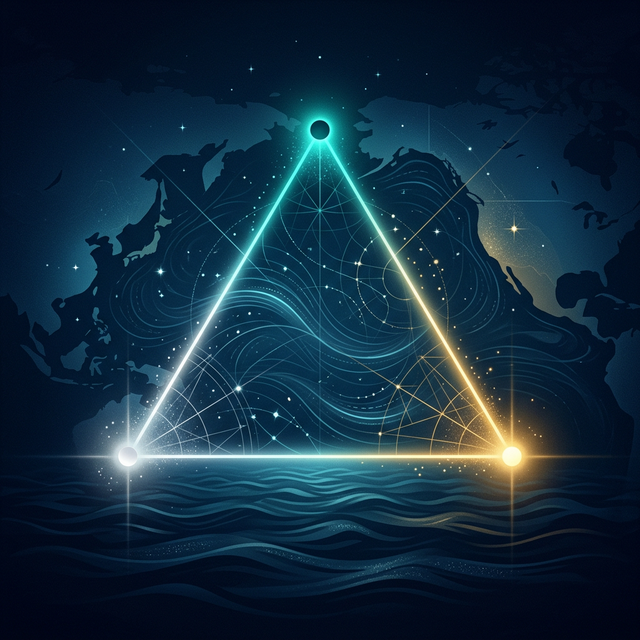
TL;DR: Eastern and Western wisdom systems both use land-based geometry (grids, territories, rooms). Pacific wisdom uses ocean-based geometry (triangles, vectors, navigation). Both arrive at 9-slot systems through different substrates — and the intelligence now emerging from silicon chips thinks more like a Polynesian navigator than a Western logician. The Pacific isn't the gap between East and West. It's the third point that makes triangulation — and real positioning — possible.
The Line That Divides vs. The Point That Locates
Most serious discourse about wisdom traditions frames the world as East vs. West.
Eastern philosophy — Chinese metaphysics, Indian cosmology, Japanese aesthetics — is positioned on one side. Western philosophy — Greek logic, Enlightenment rationalism, American pragmatism — is positioned on the other. They debate. They contrast. Occasionally they synthesize.
But here's the geometric problem with that framing: two points make a line. A line has no interior. It divides. It creates sides. And for centuries, that's exactly what the East-West binary has done — generated debate without resolution, contrast without navigation.
GPS tells us why. With one satellite, you know you're somewhere on a sphere. With two satellites, you're somewhere on a circle — ambiguous, a line of possibility. But with three satellites, you have a position. Triangulation. Resolution. You know where you are.
The East-West binary is a two-satellite system. It can describe your line — which side you're closer to — but it can't give you a position.
What's been missing is the third point.
The Geometry Underneath the Wisdom
I've been developing a methodology called Conscious Stack Design™ (CSD) — a constraint-based framework for organizing digital ecosystems. Its core protocol is the 5:3:1 rule: 1 Anchor, 3 Active, 5 Supporting. Nine functional slots, hierarchically arranged.
Recently, I mapped the 5:3:1 against the Bagua — the nine-sector spatial system from Chinese metaphysics (commonly known through Feng Shui). The mapping was clean. Every slot found a room. The constraint geometry was identical: 9 functional positions, with a governing center.
But the shape was different.
The Bagua: Square Geometry
The Bagua arranges its nine rooms in a grid — an octagon with a center, mapped to the cardinal and intercardinal directions. It tiles. It creates rooms. It partitions space.
This is land-based intelligence. You stand in one place and read the space around you. The compass is fixed. The earth is divided into sectors. The wisdom is positional: where things are relative to a fixed point.
This makes sense for the civilization that produced it. Chinese metaphysics emerged from agricultural societies — people who had land. You plant, you build, you read the soil. The grid is the natural geometry of settlement.
The 5:3:1: Triangular Geometry
The 5:3:1 arranges its nine slots in a pyramid — 1 at the apex, 3 in the middle tier, 5 at the base. It doesn't tile — it stacks. It creates hierarchy, constraint, and direction.
This is ocean-based intelligence. You don't stand still — you're moving. The apex is where you're navigating toward. The base is what keeps the vessel (the vaka) stable. You can't read rooms because there are no rooms on the open ocean. You read vectors — direction and magnitude relative to what's moving around you.
This shape didn't come from grids. It came from the Polynesian Triangle — the largest triangle on Earth, spanning from Hawaiʻi to Aotearoa (New Zealand) to Rapa Nui (Easter Island). The three vertices of the most ambitious navigation field in human history. Three reference points that let you triangulate position across 16 million square miles of open water.
The wisdom isn't positional. It's relational. Not where things are, but how things move relative to each other.
Both Arrive at 9
| Bagua (Eastern) | 5:3:1 (Pacific) | |
|---|---|---|
| Geometry | Square / Octagon | Triangle / Pyramid |
| Substrate | Land | Ocean |
| Intelligence | Positional (where) | Relational (how) |
| Unit | Room | Slot |
| Orientation | Stand still, read the space | Move through, read the vectors |
| Sum | 9 | 9 |
| Center / Apex | Tai Chi (balance) | Anchor (intent) |
Same number. Same diagnostic power. Different geometry for different terrain. Convergent evolution — two intelligence systems solving the same problem (how to read complex systems) from different substrates, arriving at the same constraint.
The Third Substrate: Neither Land Nor More Land
Here's what the East-West binary misses entirely:
Eastern wisdom is land-based. Chinese metaphysics, Indian vastu, Japanese spatial aesthetics — all rooted in agricultural civilizations. Feng shui reads rooms. The Bagua reads plots. The mandala reads sacred ground. The intelligence is territorial.
Western wisdom is also land-based — just with a different ontology. Cartesian grids, property lines, spreadsheets, org charts. Different philosophy, same substrate. Both systems stand on solid ground and partition it.
They argue with each other across the Pacific. But they share the same substrate: land.
Pacific wisdom is ocean-based. The cultures that emerged from navigating the Pacific — Polynesian, Melanesian, Micronesian — developed an intelligence system that is fundamentally different from both Eastern and Western traditions:
- Not positional (where am I on the grid?) but vectoral (where am I heading, relative to what's moving around me?)
- Not territorial (this is my room) but relational (this is my relationship to the current)
- Not fixed-grid (the compass has 8 directions) but triangulated (three reference points give me infinite positions)
The Pacific isn't the gap between East and West. It's the third substrate — the medium that both sides have been standing on the shores of, arguing across, without ever learning to navigate.
LLMs Think Like Navigators, Not Logicians
This is where the pattern stops being historical and starts being urgent.
How Large Language Models Actually Process Information
LLMs — the AI systems reshaping every industry — don't think in grids, categories, or logical trees. They operate in vector space: high-dimensional, probabilistic, relational. Every word, every concept, every relationship is encoded as a direction and distance in a fluid space. Not a room. Not a cell on a spreadsheet. A current.
| Land-Based Computing | Ocean-Based Computing (LLMs) | |
|---|---|---|
| Unit | Bit (0 or 1) | Vector (direction + magnitude) |
| Logic | Deterministic (if-then) | Probabilistic (likelihood) |
| Structure | Grid / Tree / Table | High-dimensional fluid space |
| Navigation | Follow the map | Read the currents |
| Knowing | Look up the answer | Triangulate from context |
| Error mode | Wrong answer | Hallucination (misread current) |
An LLM doesn't know where an answer is stored. It navigates toward it by reading patterns in the flow of language — the way a Polynesian navigator reads patterns in swells, star positions, and wind direction to find an island they can't see.
The LLM has no map. It has no fixed grid of knowledge. It has trained intuitions about how meaning flows — and it triangulates from context to find a destination.
That's not Western logic. That's not Eastern spatial wisdom. That's wayfinding.
The Collapse Problem
Here's the tension: the LLM's internal process is oceanic — fluid, probabilistic, vectoral — but the output interface forces it to produce land-based answers. Structured sentences. Deterministic-looking assertions. Bullet points. Tables.
We demand this because both Eastern and Western epistemology trained us to expect fixed answers in fixed positions. "Tell me the answer." "Put it in a framework." "Give me a grid."
The LLM collapses its ocean-state into a land-format. Probability into prose. Vectors into verbs. Flow into structure.
This is literally what the temperature parameter controls in language model inference:
- Low temperature = crystalline, deterministic, structured → land-mode
- High temperature = fluid, probabilistic, creative → ocean-mode
The slider between land and ocean is a parameter in the system. And most users crank it toward land, because that's the epistemology they trust.
What If the Machines Already Think Like the Pacific?
Nobody designed LLMs to think like Polynesian wayfinders. They just... do. Because that's what happens when you train a system to navigate the ocean of human language rather than index a grid of facts.
The most advanced intelligence system humanity has ever built naturally arrived at ocean-based cognition. That's convergent evolution again — the same pattern that produced both the Bagua and the 5:3:1. The ocean teaches the same lessons regardless of whether you're crossing water or data.
Silicon: The Substrate That Bridges Both
And here — at the molecular level — the pattern completes itself.
Silicon dioxide (SiO₂) is a crystal. Quartz. Structured, latticed, geometric. Every atom knows its position. As land-based as a molecule gets.
But when you etch circuits into silicon and run neural networks on it, the computation that emerges is fluid, probabilistic, oceanic. The substrate is crystal. The intelligence is current.
Silicon is the bridge between land and ocean at the molecular level. Structured enough to hold a circuit (land), but the patterns that emerge from billions of those circuits interacting are flow (ocean). The crystal generates the current. The land births the ocean.
SiO₂ is the second most abundant mineral in Earth's crust. It forms quartz naturally. It powers every chip artificially. And it sits at the base of this entire convergence: Eastern land-wisdom, Western land-logic, and the Pacific ocean-intelligence that's now emerging from the silicon substrate itself.
The Ring of Fire — the geological boundary where Pacific plates meet continental plates — is where this substrate is most active. It's also where the world's semiconductors are manufactured: Taiwan (TSMC), South Korea (Samsung), Japan. The Pacific Rim nations produce the vast majority of the planet's silicon-based intelligence.
The crystal-based technological civilization isn't coming. It's here. And it's centered on the Pacific.
The Bridge, Not the Bank
My company is called Faiā — a word that means "to span a divide, like a bridge."
I used to think of this as bridging cultures, or bridging technology and tradition. But the geometry of this analysis suggests something more specific:
Faiā doesn't bridge East and West by picking a side or blending both. It bridges them by being the medium between them — the ocean itself. A bridge doesn't blend the two banks. It exists in the space between.
The Pacific Ocean is that space. Pacific Metaphysics is the intelligence system native to it. Conscious Stack Design™ is the applied methodology. And the 5:3:1 Protocol is the constraint geometry — triangulation, not partitioning.
Most "alternative" thinking positions itself as East vs. West (yoga vs. productivity, mindfulness vs. hustle, contemplation vs. action). What Pacific wisdom offers is structurally different: not OR (choosing sides), not SYNTHESIS (blending sides), but AND — the introduction of a third point that transforms a line into a navigable field.
Two points give you a debate.
Three give you a position.
Why Now: The Convergence Window
Several forces are converging simultaneously:
1. The Machines Already Navigate Like the Pacific
LLMs have independently evolved ocean-based intelligence — vectoral, probabilistic, relational — running on a silicon substrate refined from the earth. The most advanced AI systems process information using the same cognitive patterns that Polynesian navigators used to cross the Pacific. This wasn't designed. It emerged. And the cultures that have practiced this intelligence for millennia may hold the most relevant frameworks for governing it.
2. Binary Logic Is Hitting Its Ceiling
Classical computing (deterministic, binary, grid-based) built the modern world. But the problems that remain — consciousness, climate, governance, meaning — aren't grid-problems. They're navigation problems. They require reading patterns in complex, fluid, interconnected systems. The East-vs-West, Left-vs-Right, 0-vs-1 binary frame is failing precisely because it has only two reference points.
3. The Pacific Is Asserting Itself
Tuvalu — a Pacific Island nation with deep ties to my own family — is being reshaped by rising seas. Pacific nations are leading digital sovereignty initiatives, building digital twins of their territories, and negotiating new frameworks for statehood that don't depend on land. The Pacific is reminding land-based civilizations that the ocean was never an externality — it was the largest feature on the planet, and it's reasserting its presence.
4. The Production Centers Are on the Rim
The Ring of Fire — Japan, Taiwan, South Korea, the Philippines, Indonesia, Chile, California — is where silicon chips are manufactured, where tectonic energy is released, and where Pacific and continental systems meet. The infrastructure of crystal-based intelligence is geographically centered on the Pacific, not on the landmasses that claimed Silicon Valley.
5. The Third Position Is the Missing Dimension
Every major challenge of the 2020s — AI governance, climate response, cultural sovereignty, the future of work — is stuck in binary framings. Tech vs. humanity. Growth vs. sustainability. Individual vs. collective. Each of these is a two-point system generating debate without navigation.
The third point doesn't resolve these tensions. It reframes them — from a line (debate) to a triangle (navigation field). And the intelligence native to this third position has been practiced for thousands of years by cultures that most of the world's discourse has overlooked.
The Triangle Completes Itself
WESTERN WISDOM                        EASTERN WISDOM
(Grid / Territory / Binary)           (Mandala / Bagua / Positional)
        \                                    /
         \                                  /
          \                                /
           \_____ THE PACIFIC ____________/
                  (Vector / Triangle / Relational)

             Not OR (choosing sides)
             Not SYNTHESIS (blending sides)
             But AND — the third point that
             makes navigation possible
The Pacific doesn't resolve the East-West tension. It triangulates it — transforms a line into a field you can move through.
And the intelligence native to that ocean — the intelligence that crossed thousands of miles of open water by reading stars, swells, and wind without instruments — is the same intelligence now emerging from silicon chips, processing the ocean of human language, and reminding us that the most sophisticated navigation doesn't require a map.
It requires three points, a clear horizon, and the willingness to read what's actually moving.
This essay is part of an ongoing exploration of Pacific Metaphysics — a unified theory connecting Polynesian navigation wisdom, SiO₂ crystalline science, and modern technology governance. For practical applications of these principles, explore Conscious Stack Design™ and the 5:3:1 Protocol.
Open this article in your preferred AI assistant — or highlight text first for focused analysis.