The question that started it
What would it look like to speak about “Pacific Metaphysics” the way Chinese metaphysics is often taught today — not as one tribe’s doctrine, but as a coherent navigation system?
Not a single book. Not a single guru. More like a council-held map.
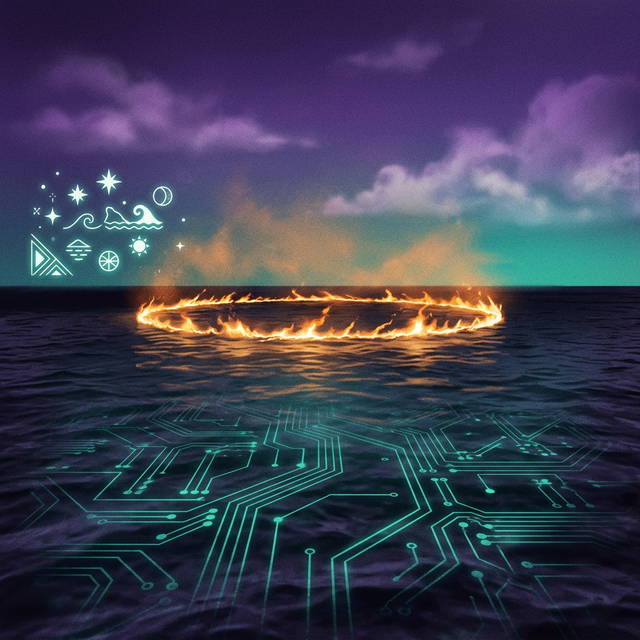
“Pacific” isn’t empty space — it’s a circuit
Most modern people see the Pacific as distance: scattered islands in a far sea.
But my maternal ancestors didn’t relate to it as emptiness. They related to it as connection.
Here’s the frame that’s been landing for me:
The Moana (the Pacific Ocean) is the Archive — the living memory of relationships, ancestors, and migrations.
The Ring of Fire is the Boundary of Manifestation — where land is born, where tectonic pressure becomes form.
The space between (the Vā) is not nothing; it is the active field where life happens.
So instead of “islands separated by water,” I’m exploring “water that holds islands in relationship.”
Fire in the water: why the Ring of Fire matters
If we only think “South Pacific” when referring to the Pacific, we miss the whole perimeter intelligence.
The Ring of Fire is also known as the Pacific Rim. And it isn’t just a border. It’s the Pacific’s nervous system.
Volcanoes, earthquakes, hot springs, black sand beaches. They’re the visible (geological) breath of a deeper force: pressure, transformation, emergence.
In this frame, life doesn’t just happen on land.
Life happens where Fire meets Water.
The serpent beings as threshold-guardians
What really triggered this inquiry is a recurring pattern around the Rim: serpent/dragon/nāga/eel beings showing up again and again.
Different names, different protocols, different lineages — but a strangely consistent “job description”:
guardians of waterways, caves, springs, coastlines
keepers of treasure and hidden knowledge
beings who punish disrespect and reward right relationship
shapeshifters — not fixed, but responsive
I’m not trying to collapse these traditions into one myth.
I’m listening for a shared structure: a trans-Pacific grammar of guardianship.
A unified theory without erasing sovereignty: the council model
When people ask, “why hasn’t someone unified Pacific metaphysics the way other systems have been packaged?” I think the answer is partly ethical.
Much of this knowledge is held as tapu — not for extraction, not for mass replication.
And “pan-Pacific” labels can become another quiet colonization if they flatten what is distinct.
So I’m experimenting with a different architecture:
a council model (stewards, not owners)
many rooms, with geometric constraints, but shared foundations
protocols for what is public, what is contextual, what must stay in-place
In other words: coherence without capture.
The living circuit: a working blueprint
This is the simplest version of the map I’m carrying right now:
Moana (Water): the relational archive — memory, ancestry, the highway of connection.
Ahi / Fire: the pressure of becoming — land-birth, will, transformation.
Vā: the active field between — where harmony and conflict actually live.
Guardians: the threshold beings — the keepers of passage, place, and protocol.
Wayfinding: the practice — not belief, but orientation.
Why I’m taking this seriously (and gently)
Part of why I’m using AI in this exploration is simple: it helps me see the pattern faster.
But the pattern isn’t the point.
The point is relationship — to place, to elders, to lineages, to living communities, to the ethics of knowledge itself.
So I’m treating this as a voyage framework, not a product.
A way to travel the Rim and listen: to volcanoes, to stories, to water, to the serpent synapses where something ancient still moves.
What I’m exploring next
A “Pacific Rim voyage map” of serpent/dragon/eel sites and their protocols (by place, not by theory).
A vocabulary list of shared principles (Vā, mana, tapu, whakapapa/gafa, vanua/whenua) with sovereignty intact.
A distinction between poetic scaffolds (helpful metaphors) and lineage claims (which require permission and proof).
If you carry any stories, names, or protocols from your side of the ocean — I’d love to hear what you think: what is preserved when we connect the Rim, and what gets distorted when we try?
Comments