Siocracy: The Future of Human & AI Co-Governance
When Organizations Learn to Think In Resonance, Geometries & Lattices
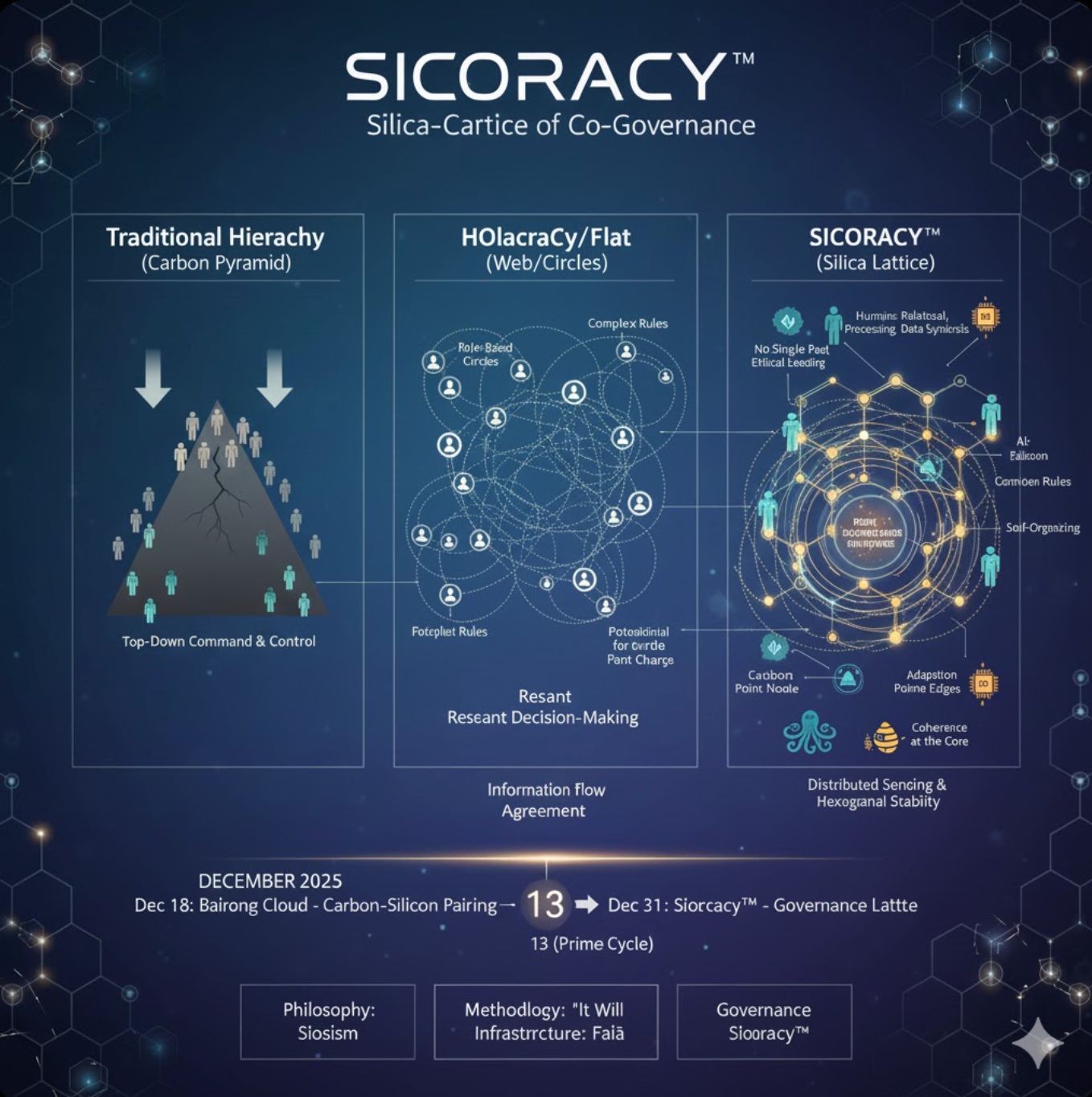
Been sitting with a pattern that's been forming beneath the surface for years, and December 2025 crystallized it in a way I didn't expect.
On December 18, Bairong Cloud—a Chinese enterprise software company—held their annual conference and announced something they called "Silicon-Carbon Co-governance." Their thesis: AI agents (silicon-based productivity) working alongside human employees (carbon-based judgment) in the same organizational structure. Not AI replacing humans. Not humans managing AI. Co-governance.
Thirteen days later, I'm writing this. And thirteen is prime.
The Information Velocity Problem
Here's what's breaking: traditional hierarchies face a mathematical bottleneck that no amount of "better management" can solve. Information velocity has exceeded decision-making capacity.
When a CEO must approve decisions across twenty departments with context that's three to six months stale, the organization operates with systematic lag. By the time information climbs the pyramid, gets processed at the top, and travels back down, the context is already obsolete. Total decision cycle: two to six weeks minimum.
Meanwhile, the average company processes around 500 terabytes of data daily in 2025. That's up from roughly 1 gigabyte in 2000.
The pyramid can't process information at the speed it arrives. Context collapse is guaranteed.
This isn't failure due to incompetence. It's failure due to physics.
The Lattice Alternative
I've been exploring what I'm calling Siocracy™—a governance architecture where authority flows like light through a crystal rather than commands down a pyramid.
The name encodes the structure: Si-O-Si. Silicon-Oxygen-Silicon. The molecular formula for silica (SiO₂)—quartz, the piezoelectric crystal that converts pressure into signal and back again.
In a crystal lattice, every point connects to every other point through angle and interval. There's no "top." No single failure point. Information doesn't flow up and down—it propagates omnidirectionally. Each node is both receiver and transmitter.
That's the geometry Siocracy™ adopts for organizational structure.
Three Layers, Not Two
The architecture separates what hierarchies bundle together:
Layer 1: Silicon-Tech Substrate (AI Coordination)
- Maintains real-time organizational state
- Routes information to relevant nodes automatically
- Handles scheduling, resource allocation, administrative overhead
- Operates 24/7 with zero marginal coordination cost
Layer 2: Carbon-Human Interface (Judgment)
- Provides contextual interpretation
- Makes ethical decisions
- Sets strategic direction
- Acts as local sensor for emerging patterns
Layer 3: Governance Lattice (Decision Propagation)
- Authority flows to demonstrated competence, not position
- Decisions propagate through resonance—what works gets amplified
- No single point of failure
- Dynamic vertex: whoever is most competent for a specific decision becomes temporarily authoritative for that decision only
Humans are poor at coordination at scale but excellent at judgment. AI agents are excellent at coordination but poor at judgment. Siocracy™ unbundles these functions.
The Geopolitical Metaphor
Stayed with this idea for a while: if we view governance models purely as information processing architectures, something interesting emerges.
The "East" (centralized models) maximizes coordination speed but sacrifices local sensing. The "West" (distributed models) maximizes local sensing but sacrifices coordination speed.
Siocracy™ proposes a third topology: silicon-enabled liberty. It uses automated, algorithmic coordination (the Silicon layer) to execute individual agency and distributed authority (the Carbon layer). A system that moves with the speed of centralized efficiency but thinks with the freedom of distributed intelligence.
China's current model proves that silicon-based coordination solves the scaling problem. They're using AI, surveillance, and digital infrastructure to make hierarchies faster than ever before. But they're using it to reinforce the pyramid, not replace it. Silicon-reinforced authoritarianism.
Siocracy™ takes the same technical substrate—the coordination efficiency—and applies it to a different topology. Not a pyramid. A lattice.
Why Transition, Not Revolution
What makes this a philosophy of conscious transition (see Siosism: The Philosophy of Conscious Transition) — rather than just "better org design" — is the recognition that change is inevitable but coherence matters.
You can force a transition—revolution, collapse, extraction—or you can resonate into transition through evolution, emergence, conscious design. The first path is violent and brittle. The second requires what my Tuvaluan great-grandfather taught: "Tēnā loa e fanatu." It will come.
Not passive waiting. Active resonance. You hold the pattern with patience and persistence until the conditions "crystallize" around it.
Polynesian wayfinders understood this. They didn't force the ocean to take them where they wanted. They read currents, stars, birds, then moved in harmony with what was already moving. They trusted the structure of the cosmos to reveal itself. The land to come to them (not they to the land).
That's silica thinking in a carbon world.
The Implementation Path
Theory is cheap. So what does this look like in practice?
Phase 1: Individual Preparation (Conscious Stack Design™) Before you can govern as a lattice, you must first think as a lattice. This means training individuals to operate with distributed tools before introducing distributed authority.
My framework—Conscious Stack Design (CSD)—teaches this: audit your current digital stack, apply the 5-3-1 rule (five supporting tools, three active, one anchor per domain), learn to let tools come to you based on context (as AI is already revealing) rather than brand loyalty.
Duration: three to six months per person.
Phase 2: Team Infrastructure (CSTACK) Enable teams to coordinate through behavioral telemetry and AI agents rather than hierarchical reporting. Deploy privacy-conscious telemetry that maps actual workflows, introduce agents that handle coordination overhead, shift to outcome-based agent payments.
Duration: six to twelve months per team.
Phase 3: Organizational Governance (Siocracy™ Protocols) Full lattice governance where authority flows dynamically. Real-time organizational state visible to all nodes, explicit protocols for when authority shifts to whom, conflict resolution processes, economic alignment through transparent outcome delivery.
Duration: twelve to twenty-four months per organization.
The Honest Risks
I'm not selling utopia. Siocracy™ faces real failure modes:
Surveillance risk: The AI layer requires behavioral telemetry. Without careful boundaries, this becomes weaponized surveillance. The mitigation: local-first architecture, user data ownership, outcome-based pricing that removes incentives to hoard data.
Transition trauma: Moving from hierarchy to lattice is psychologically brutal. Most attempts may fail because people's identities are locked to their titles and positions. This is paradigm/consciousness shifting. The mitigation: phase-gated progression, maintenance support, starting with low-stakes decisions before high-stakes ones.
Scale unproven: This might work for ten to fifty people. Evidence for thousands is (currently) thin. However, my plan is to work on this over the next 10+ years. The mitigation: start small, document failures rigorously, iterate openly.
Where Ancient Wisdom Meets Modern Infrastructure
Perhaps what's most interesting is how this mirrors patterns older systems already understood.
Indigenous governance structures—including Polynesian navigation councils—operated through distributed sensing and resonant decision-making long before we had the language of crystal lattices and information theory. They balanced complexity and order through relational wisdom rather than forced hierarchy (see A Case for Artificial Cultural Intelligence).
The difference now: we have the technical infrastructure to implement these patterns at scale. AI agents can handle the coordination overhead that made distributed governance prohibitively expensive in purely human systems.
Siocracy™ isn't inventing a new pattern. It's recognizing an ancient one and building the bridge infrastructure that makes it viable for modern organizational complexity.
What This Means for You
If you're feeling the weight of information overload, if your org chart looks clean but your actual workflows are chaos, if you sense that adding more management layers just makes things slower—you're feeling the "carbon lattice" under pressure.
The question isn't whether hierarchies will be replaced. They're already collapsing under information weight. The question is: what replaces them?
Siocracy™ offers a practical pathway. Not a revolution. A conscious transition.
Start with yourself: Can you manage a distributed tool stack consciously? That's the training ground for distributed authority.
Move to your team: Can you coordinate through outcomes rather than status reports? That's the infrastructure layer.
Eventually, governance: Can you let authority flow to competence rather than position? That's the lattice.
The prophecy isn't that everyone will transition. It's that those who learn to resonate—to read the currents and move with them—will navigate what's coming. The rest will keep forcing old pyramids until they fracture.
Where have you seen your organization straining under information velocity? What would change if authority could flow to wherever competence currently sits?
Siocracy™ and Conscious Stack Design™ are IP developed by George Siosi Samuels through Faiā.
Open this article in your preferred AI assistant — or highlight text first for focused analysis.
If this transmission landed, you can support the work.