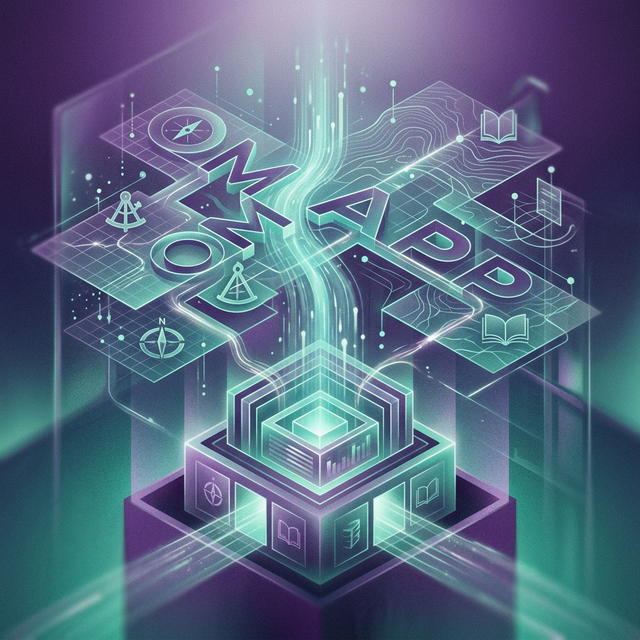
TL;DR: The astronomers who mapped the stars survived through their documentation systems, not just their discoveries. OMAPP (Observation, Method, Analysis, Publication, Preservation) is that system adapted for modern knowledge work.
I started researching Nicolas-Louis de La Caille because of some questions I had about Zeta Reticuli. The star system sits in the constellation Reticulum, the "net," and I was curious about the geometry. Zeta means six. Six points. A net. The pattern forms a rhomboid when you trace the connections.
That led me to the man who cataloged it all in the 1750s.
What struck me was not just what La Caille discovered, but how he worked. He and others of his era—Flamsteed, Halley, the Herschels—left legacies because they transformed raw observation into structured artifacts. Star catalogs. Navigation tables. Geodetic records. Instrument logs. Their notebooks outlived them because they understood something we forget today: observation without documentation is just noise.
Their method was not complex. It was rigorous. And it translates directly to how we should handle knowledge work now, especially in a world drowning in tool sprawl and fleeting insights.
What made the old greats last

The astronomers of the 18th century worked under constraints we would recognize. Limited instruments. No version control. No cloud backup. Yet their measurements remain citable centuries later.
They succeeded because they built trust pipelines:
Observation: Capture the raw signal. Timestamped. Unpolished. With full context about conditions, instruments, and caveats.
Method: Document how you touched reality. Calibration steps. Sampling decisions. Instrument settings. The protocol matters as much as the result.
Analysis: Transform signal into sense. Show your computation. Make it reproducible. Others should be able to rerun your work or extend it.
Publication: Crystallize shareable artifacts. These are the catalogs and tables that others can cite, build on, and verify.
Preservation: Safeguard integrity across time. Use checksums, stable identifiers, and immutable snapshots so future navigators can trace lineage.
La Caille's southern-sky catalog worked because every layer reinforced the next. His geodetic paradox—the pear-shaped Earth measurement—survived scrutiny because Maclear could retrace his exact steps decades later and isolate the gravitational anomaly.
That is the architecture: each stage strengthens what comes after.
Introducing OMAPP
We are not cataloging stars. But we are mapping complexity. Strategy decks. System designs. Research threads. Client work. Internal frameworks.
Most of it evaporates because we treat documentation as an afterthought. We capture the polished output but lose the reasoning. We skip method notes. We let insights scatter across tools with no preservation layer.
OMAPP fixes that.
Think of it as a living organism:
Observation is the bloodstream. Fresh signals, captured with minimal processing. Append-only logs. Raw files. Timestamps and provenance.
Method is the nervous system. How you sensed what you sensed. The protocol that others can follow or critique.
Analysis is the organs. Code notebooks. Computation pipelines. Version-controlled and environment-tagged so results are reproducible.
Publication is the skin. Stable artifacts with citations and DOIs. The interface others interact with.
Preservation is the spine. Immutable snapshots. Human-readable narratives paired with machine-readable schemas. Truth that endures change.
When you structure knowledge this way, it breathes. It evolves without breaking. Future you can retrace it. Collaborators can extend it. LLMs can cite it accurately.
Why this matters for digital wayfinders
A map is a snapshot. Fixed in space and time.
OMAPP is an adapted compass. It adapts as the terrain shifts.
For operators, founders, and systems builders, this distinction is critical. You are not just documenting what you know. You are encoding how you came to know it so the knowledge can compound — something that’s going to become increasingly prevalent in an AI-dominated future.
Consider these 3 patterns:
Pattern #1: Strategy without method . You build a brilliant framework. Ship a deck. Three months later, someone asks how you derived a key assumption. You cannot reconstruct it. The insight is orphaned.
Pattern #2: Analysis without preservation. You run a complex model. Share the output. The notebook gets lost in version churn. No one can verify or extend your work. Trust erodes.
Pattern #3: Observation without publication. You capture rich signals in daily logs. They never leave your private vault. The patterns you see remain invisible to collaborators and future readers.
OMAPP closes those gaps. It treats knowledge as infrastructure, not exhaust.
OMAPP in practice
Here is what it looks like in a modern, conscious stack:
Layer | What you do | Tools and habits | “Conscious Stack” Example |
|---|---|---|---|
Observation | Capture raw signals with context | Daily logs, timestamped entries, unprocessed files in canonical store | Notion |
Method | Document your protocol | Lab notes, instrument metadata, decision logs linked to exact runs | Notion AI |
Analysis | Show your computation | Code notebooks under version control, environment specs, dataset hashes | GitHub |
Publication | Release stable, citable artifacts | Curated datasets with DOIs, preprints, method summaries | Substack |
Preservation | Safeguard across time | Immutable snapshots, checksums, human and machine schemas | [Blockchain] |
You do not necessarily need five separate tools. You need five intentional tools or practices woven into your existing flow.
What this is not
OMAPP is not:
A project management system. It is a knowledge custody protocol.
A replacement for your stack. It is a constraint that shapes how you use it.
A rigid process. It is a spine that lets the rest flex.
You can apply it to a single research thread or an entire organization. The scale changes. The structure holds.
FAQ
Q: Is OMAPP only for technical work?
No. It applies to any knowledge work where lineage and reproducibility matter. Strategy. Design. Writing. Systems thinking. If someone might need to trace your reasoning or build on your work, OMAPP creates the scaffold.
Q: How is this different from just taking good notes?
Good notes capture what you did. OMAPP captures how, why, and in what order, with explicit links between stages. It turns notes into navigable infrastructure.
Q: Do I need all five layers for every piece of work?
No. But knowing which layers you are skipping helps you manage risk. Skip preservation on a throwaway prototype. Do not skip it on foundational research.
Q: How does OMAPP relate to Conscious Stack Design™?
OMAPP is a documentation protocol. CSD is a stack design methodology. They reinforce each other. CSD constrains your tools. OMAPP structures how you document the work those tool configurations (stacks) enable.
The O-Map insight
Here is another reframe that might make OMAPP stick even more:
A traditional map is static. An “O-Map” — the OMAPP as a structured knowledge system within our digital world — is alive and dynamic. It responds to new observations. It preserves old ones. It lets you zoom in on method or zoom out to publication without losing coherence.
For modern digital wayfinders, this is the difference between collecting insights and building knowledge infrastructure.
La Caille and his peers understood this in the 1750s. They worked with quills and parchment. We work with Notion and Git. The medium changed. The principle holds.
Operate from structure, not just capture.
If you are building systems, frameworks, or strategy—anything that others might need to trust, cite, or extend—consider running it through the OMAPP lens. Not as bureaucracy. As clarity.
You might already be doing pieces of it. The shift is weaving them into a single, traceable arc.
Comments