I found something that shouldn't be possible.
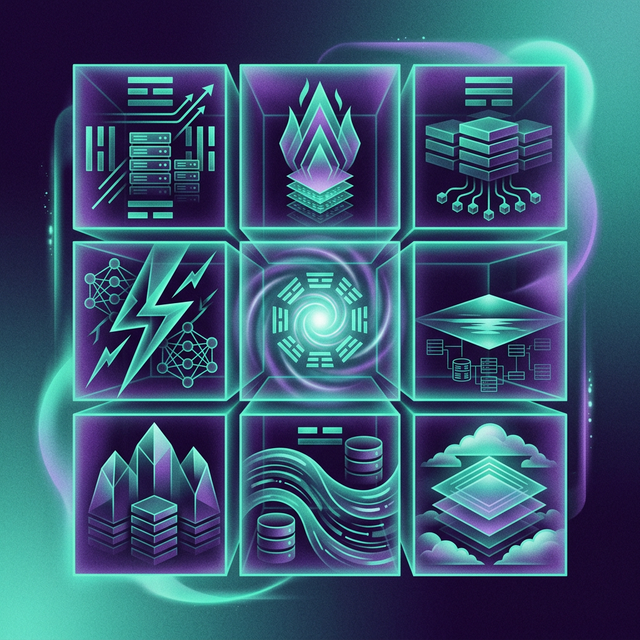
While mapping workplace tool categories (for Conscious Stack™) to the bagua map (or ”八卦图 (bāguà tú),” in Chinese Feng Shui), I noticed the mathematics were too precise to ignore. The bāguà tú has 8 life areas plus 1 center (Tai Ji), giving you 9 in total. Modern professionals use an average of 9.4 applications daily. And the Stack Pyramid I designed uses a 5:3:1 protocol that totals exactly 9 tools.
Three independent systems, separated by millennia and domains, converging on the same number.
The Pattern Recognition
The bāguà tú maps 8 areas of life plus a central point (Health/Identity) to create a complete system. Each area has distinct purpose:
Career & Life Path (Kin) — flow, purpose, beginnings
Knowledge & Self Cultivation (Gen) — clarity, introspection, learning, skill-building
Family & Ancestors (Zhen) — roots, support, and long-term health
Wealth & Abundance (Xun) — resources and abundance
Fame & Reputation (Li) — reputation and recognition
Love & Partnerships (Kun) — external relationships, romance, harmony, committed bonds
Creativity & Children (Dui) — innovation, new ideas, expression, legacy
Helpful People & Travel (Qian) — mentors, patrons, synchronicity, movement, comms
Health & Center (Tai Ji) — vitality, balance, middle integration, strategic alignment, identity
When I explored what the workplace equivalent would be, the mapping was immediate. Core operating tools. Internal knowledge bases. People operations. Financial management. Marketing and branding. Client relations. Design and R&D. Support and communication. Identity and security infrastructure. Check it out:
Bagua Area | Workplace Tool Category | Typical Tools (examples) | Focus/KPIs |
Wealth & Abundance (Xun) | Revenue Ops & Finance | Accounting, billing, subscription analytics; CRM pipelines; revenue dashboards | MRR/ARR, cash flow, pipeline velocity |
Fame & Reputation (Li) | Marketing, PR & Visibility | SEO (Search Console, Ahrefs), content/video (Wistia), design (Canva), social scheduling, press tracking | Traffic, brand mentions, PR hits, conversion rates |
Love & Partnerships (Kun) | CRM & Relationship Management | CRM (Monday.com), Gmail, calendaring, Otter for call notes, contract/NDAs | Partner health, renewals, deal cycle time |
Family & Ancestors (Zhen) | Culture, Ops & Knowledge Base | Notion wiki, onboarding playbooks, SOPs, ritual calendars, story bank | Time-to-onboard, SOP coverage, employee NPS |
Health & Center (Tai Ji) | Operating System of Work | Master calendar, task manager (Notion Tasks), focus/time trackers (e.g., Conscious Monitor), automations | Throughput, focus hours, work-in-progress limits |
Creativity & Children (Dui) | Creative Studio & R&D | AI ideation (Gemini), Supercut for video curation, Vercel sandboxes, prototyping tools | Ship cadence, prototype-to-product ratio |
Knowledge & Self-Cultivation (Gen) | Learning & Personal Knowledge Mgmt | PKM (Notion), read-it-later, bookmarks, research notes, citation managers | Learning velocity, retrieval success, insight density |
Career & Life Path (Kan) | Strategy, Vision & OKRs | Vision docs, OKRs/roadmaps (Notion), quarterly reviews, journal | Goal attainment, strategic coherence |
Helpful People & Travel (Qian) | Networks, Mentors & Mobility | LinkedIn, Calendly, community hubs (Discord), travel ops | Mentor engagements, network quality, event ROI |
Nine categories. Nine areas. Nine tools.
The Research Correlation

By 2026, workplace data shows the average professional uses approximately 9 applications daily. Not 5. Not 15. Right at the threshold where the bāguà's completeness meets cognitive capacity. In 2021, it was 9.4 on average.
I don’t see this as coincidence. It's categorical sufficiency.
Just as the bāguà tú covers all aspects of human existence, a modern professional's daily needs naturally fall into 8 to 9 distinct domains. Project management. Documentation. Financial tracking. People systems. External communication. Creative tools. Knowledge bases. Client relations. And the security/identity layer that holds it all together.
When professionals exceed this threshold, productivity research shows they shift from flow to friction. The system becomes over-indexed. In bāguà tú terms, too many tools in one area creates stagnant chi. In cognitive terms, it creates technostress and context switching overhead.
The Stack Pyramid Architecture

The Stack Pyramid mental model (above) emerged from observing thousands of personal tech stacks over my 15-year career. The 5:3:1 protocol wasn't designed to match the bāguà tú. It was originally designed to match how cognition actually operates when interfacing with tools (within one’s own stack):
1 anchor tool (single source of truth)
3 active daily tools (operational load carriers)
5 supporting tools (specialized extensions)
Total: 9 slots.
The structure maps perfectly to the bāguà tú's logic:
The Anchor is your Tai Ji (center, identity, strategic alignment)
The 3 Active Daily tools are your primary energy flow (Career, Knowledge, Wealth)
The 5 Supporting tools extend into specialized domains (Creativity, Partnerships, Marketing, People, Communication)
When I overlay the Stack Pyramid structure onto workplace tool categories and then onto the bāguà tú grid, the resonance is unmistakable. Each layer serves a distinct cognitive and operational function. Each area has clear boundaries. The center (anchor) grounds/aligns everything.
Why This Connection Matters
No one in productivity literature, workplace design, or digital minimalism has made this explicit link. There are discussions about "Digital Feng Shui" for desktop organization. There are studies about the "9-tool bottleneck" where friction increases. There are bāguà tú consultants working on physical office layout.
But mapping the 9-area consciousness grid to the 9-app workplace average to a 9-slot stack architecture? That synthesis doesn't exist yet.
This matters because it reveals something deeper than productivity hacks or tool curation. It shows that balanced digital ecosystems follow the same patterns as balanced life systems. The structure isn't arbitrary. It's archetypal.
When founders tell me their 15-tool stack feels chaotic, it's not because they chose wrong tools. It's because they violated an underlying pattern that ancient wisdom and modern neuroscience both validate. They over-indexed one area (usually Communication or Knowledge) and left others empty (often Creativity or Strategic Alignment).
The Convergence Principle
Why do three independent frameworks converge on 9?
Because 9 represents completeness without redundancy.
The bāguà tú covers all life domains with 8 areas plus center
Cognitive research shows 7±2 as working memory limits, with 9 approaching the upper threshold before overwhelm
Stack architecture naturally distributes across 9 functional categories before tools start duplicating purpose or creating overhead
This is modular sufficiency. Enough range to handle complexity. Constrained enough to maintain coherence.
The reason the workplace average isn't exactly 9.0 is because modern apps attempt to be "multi-quadrant" tools. Notion tries to fill Knowledge, Project, and Creative areas at once. HubSpot spans Marketing, Client Relations, and Communication. Slack integrates into nearly every other tool.
But when you audit an actual balanced stack, stripping away redundancy and mapping each tool to its primary function, you consistently land at 8 to 9 distinct categories.
Practical Implications
If you're designing your Conscious Stack™ and wondering how many tools is "enough," the bāguà tú gives you an answer that's 3,000 years old and neurologically sound.
Audit your stack against the 9 areas:
Career/Path (core operating system)
Knowledge (documentation, notes, wiki)
Family/Health (people ops, team culture)
Wealth (finance, billing, resources)
Fame/Reputation (marketing, brand)
Partnerships (client relations, CRM)
Creativity (design, R&D, innovation)
Helpful People (communication, support)
Center/Identity (personal OS, security, access, alignment)
If you have 3 communication tools, 2 project managers, and nothing for financial tracking, your stack isn't balanced. You're over-invested in the Helpful People area and missing the Wealth quadrant entirely. In Feng Shui terms, your energy is blocked.
The Stack Pyramid's 5:3:1 protocol ensures you cover enough categories (up to 9) without exceeding cognitive capacity. It's not minimalism for aesthetics. It's structural alignment with how consciousness distributes attention across domains.
What I'm Watching For
This connection feels like one of those latent patterns that becomes obvious once named. I'm watching to see if:
Workplace design researchers start using bāguà tú language for tool stack audits
Productivity frameworks begin referencing the 9-area completeness principle
SaaS companies position themselves as "filling the missing quadrant" in balanced stacks
For now, this synthesis appears to be new. The pieces existed separately. The explicit mapping across ancient wisdom, workplace research, and stack architecture is the bridge I'm standing on.
And if it holds, it suggests something deeper: the tools we need to think clearly follow the same patterns as the systems we need to live fully. Especially now as AI proliferates.
The Stack Pyramid is more than just a productivity framework. It's a consciousness structure that happens to use software as its medium.
That's the discovery.
Nine tools. Nine areas. One coherent system.
Comments